Showing posts with label ireland student visa. Show all posts

Friday, June 10, 2011

Indian student granted leave to appeal decision in Ireland


An Indian student has been granted leave to seek a High Court challenge to a suspended sentence imposed on him in the Circuit Court on condition he leave the country.
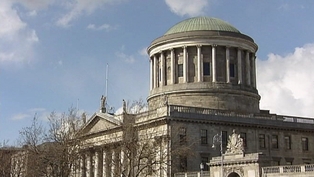
High Court - Case adjourned until 2 July
Harminder Singh of Ballykelly, Newcastle, Co Dublin, claimed Circuit Court Judge Patrick McCartan was effectively deporting him by imposing the condition.
A High Court judge said the case raised 'serious concerns' about the lawfulness of such decisions.
Mr Singh claimed Judge McCartan showed bias when he commented that he had 'worn out his welcome in this jurisdiction'.
Lawyers for Mr Singh sought leave to challenge the decision on a number of grounds.
They claimed the judge had acted beyond his powers by ordering as a condition of the suspended sentence that Mr Singh leave the country.
The court heard that Mr Singh pleaded guilty to assaulting a fellow national and was sentenced on 26 May last.
An 18-month sentence was imposed but was suspended on condition he return to India.
An extension was given to allow him time to sit exams but he was required to leave by tomorrow, the court heard.
His lawyers said he had been living and working here on a student visa for the past four years and this visa was not due to expire until September next.
They claim the judge was 'treading on the executive function of deportation' by making it a condition of the sentence that he leave Ireland.
They also claimed there was no evidential basis for the comments made by the judge about his welcome in this jurisdiction having evaporated.
The assault was an isolated incident and to suggest that the Irish people no longer wanted him here was a conclusion not open to the judge to reach, the court was told.
It was also claimed the sentence was passed before an interpreter had arrived in court.
Mr Justice Gerard Hogan refused leave to seek judicial review on two of the three grounds submitted.
He said the comments by the judge did not amount to objective bias, adding that some licence had to be allowed to a Circuit Court judge dealing with serious criminal matters in the observations he makes.
He said the judge was entitled to make the comment that someone here on a student visa (who is convicted of a crime)
has overstayed their welcome.
He also refused leave on the ground that an interpreter was not present.
However, he said the requirement that the defendant leave the country as a condition of sentence was a matter that raised serious concerns about whether it was lawful for a sentencing judge to impose any conditions of this kind.
Therefore, the judge said he would grant leave to seek judicial review and adjourned the case to 2 July next.
Source: RTE News Ireland

Irish population to hit 6.5m by 2060


Ireland’s population is set to reach 6.5 million in the next 50 years, according to projections from the European Union.
The 46 per cent growth projected by EU statistics agency Eurostat places Ireland at the top of the list of countries expected to grow by 2060, closely followed by Luxembourg and Cyprus at 45 per cent and 41 per cent respectively.
The Eurostat figures are based on current population numbers and the assumption that birth rates, death rates and migration will become standardised across the EU in the long-term.
The UK, Belgium and Sweden are all expected to grow by between 23 and 27 per cent. Other countries, including Latvia, Lithuania, Romania and Germany, are expected to see falling population numbers, with Bulgaria seeing the largest drop of 27 per cent.
Ireland’s population explosion will make it the 16th most populous nation in Europe, up from its current 20th place.
The UK’s growth will likely see it overtake Germany as the most populous nation in Europe, reaching almost 79 million people in the next 50 years.
The EU as a whole will see a large increase in population across all 27 member states, peaking at 526 million people in 2040, before falling back to 517 million.
Ireland will also see its proportion of elderly citizens increase. By 2060 it is expected that people aged over 65 will account for 22 per cent of the population, with those over 80 representing 12 per cent of the total. This is double the current figure of about 11 per cent of the population over 65.
A Department of Finance report published in April identified the expected explosion of older citizens as a significant problem for long-term financial stability, saying that it would result in increases in public expenditure. An ageing population can cause problems for a country if the working population is not large enough to support the welfare needs of the elderly.
“Projections indicate that public spending on pensions, health and long-term care will increase from 12 per cent of GDP in 2007 to 15 per cent by 2030 and to 21 per cent by 2060. Potential savings from education expenditure will contribute only a small offsetting amount,” the report said.
The same report said that as a result, steps taken could include “increasing the population at work, cutting age-related spending and improving the country’s productive capacity”.
Other EU countries will be dealing with even older populations, with Latvia, Romania, Poland, Bulgaria, Germany and Slovakia all expected to have more than 30 per cent of their populations over 65.